
How Humidity Damages Stored Products Before You See It
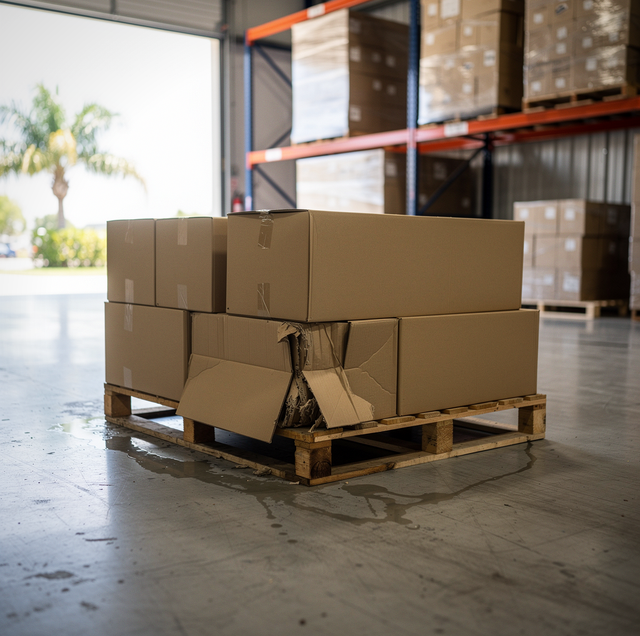
The forklift operator finds it before you do. A pallet in the third bay leans about six inches out of square, its bottom tier of cartons crushed down on one corner, the corrugated soft enough to dent with a thumb. Nothing fell on it. It was built to the same pattern as the forty pallets behind it and sat on the same rack beam for five weeks.
What changed was the air. Humidity does not work on stored goods at a steady rate, and it does not treat a whole rack alike. Two of the five mechanisms below track the moisture level continuously, so damage accumulates in proportion to what your gauge reads. The other three turn on a threshold, and you can hold a room just under one of them for a season and see nothing at all.
Stored Goods Hold Whatever Moisture the Air Gives Them
Wood, paper, corrugated board, textiles, and leather are hygroscopic: how much water vapor they hold inside their own structure is set by the relative humidity around them. Move a load into wetter air, and it takes on water until the vapor pressure inside matches the pressure outside; move it into drier air, and it gives that water back. Your material's moisture content is a reading of your room, taken on a delay.
That equilibrium number is neither small nor stable. At ordinary room temperature, wood settles at these equilibrium moisture contents:
| Relative humidity | Wood moisture content |
|---|---|
| 30% | 6.2% |
| 50% | 9.2% |
| 70% | 12.6% |
| 80% | 16.0% |
| 90% | 20.9% |
Two properties move with that number. Dimensions move because water swells the cell walls from the inside: shrinkage from green to oven-dry runs roughly 4 to 8 percent across the grain, against 0.1 to 0.2 percent along it, so a panel cups and a glued joint opens while its length holds. Strength decreases, too, because water gets between the hydrogen bonds that hold cellulose fibers together.
Which of your SKUs earn a controlled space is a sorting exercise in itself. This is about what the air does to the ones already on your rack.
Damp Corrugated Board Loses Its Stacking Strength
A carton's compression strength is a property of its board, and that board is paper: the flutes carry the column load, the liners hold them from buckling sideways, and a starch adhesive holds the assembly together. Raise the moisture content of that paper and the fibers swell, the bonds weaken, the flute walls buckle at a lower load, and the corrugating starch softens until the liner lifts at the flute tips. Box compression strength is estimated from the board's edge crush value, which is measured on board conditioned at 73 degrees Fahrenheit and 50 percent relative humidity.
Corrugated board conditioned at 50 percent relative humidity holds roughly 7 to 8 percent moisture by weight. A handheld paper moisture meter reading well above that for incoming cases means the certificate on the case no longer applies.
A box at 90 percent relative humidity keeps roughly half the compression strength it has at 50 percent, and stacking time takes a further share because a carton under continuous load creeps. A stack you laid out with a thin safety factor at 50 percent has nothing left at 85.
The bottom tier buckles at the corners where the column load runs down; the pallet settles unevenly and leans, loading the tier above off-center so the next one follows. Open the crushed cases and your product can be perfectly sound, and you still have a claim and a pallet that cannot ship. Board follows the air over hours and days, so a stack that stood through a humid stretch can go down on the Tuesday after you thought conditions came back.
A Temperature Swing Puts Water on the Product
Condensation is triggered by temperature. The dew point is the temperature at which air becomes saturated with the vapor it already carries, and any surface colder than the dew point of the air touching it collects liquid water. Your humidity reading triggers that; the temperature of the pallet determines whether it has been crossed.
Run the numbers on the air at your own dock. At 82 degrees Fahrenheit and 75 percent relative humidity, the dew point is about 73 degrees; at 78 degrees and 65 percent, about 65 degrees. Any surface below those temperatures wets immediately and continues to wet until it warms or the air changes.
The first place it lands is a trailer door. A load riding at 60 degrees has had hours to settle there, and the air around it changes in a second when the seal breaks. Nothing in the load can respond that fast, so the whole exposed face wets at once, worst at the tail where warm air mixes hardest.
The second is a cold shipment brought indoors, where the gradient sits inside the load. A 2,000-pound pallet has enough thermal mass that its outer cases warm within an hour, while the core remains cold for hours, holding every surface it touches below the dew point. The wetting migrates inward, and the damp cases you find are the ones nobody watched get wet.
The physics hands you the handling rule. You cannot dry the air fast enough to matter, so raise the surface temperature before you expose it: leave the load wrapped and let it equalize toward ambient before anyone cuts film, so the water forms on the outside of the film instead of on the corrugated and the labels.
That film of water also decides whether a label holds. A pressure-sensitive adhesive bonds by wetting the surface it is pressed onto; condensed water blocks that wetting, and the weak bond that forms does not recover once the carton dries. It is why a label adhesive has a minimum application temperature separate from its service range, and why a cockled label your scanner cannot read gets your pallet held at receiving.
Bare Metal Corrodes Above a Critical Humidity
Atmospheric corrosion is an electrochemical reaction that requires a film of liquid water on the surface to carry ions between anodic and cathodic sites. Below a certain humidity, that adsorbed film is only a few molecules thick, and the reaction has nowhere to run. On clean iron, that critical relative humidity sits near 60 percent. Under it, the rate is close to zero; over it, it climbs steeply with each additional point.
The threshold also moves down, and that is where your stored goods get caught. A hygroscopic residue on the metal, a fingerprint, a process chemical, a chloride left by a wash line, pulls water at its own critical humidity and puts a droplet on the part while your room reads 50 percent. Two lots of bare steel can leave the same bay in different condition, and the difference is what was on the surface when they went in.
Mold Starts at the Surface, Where Humidity Runs Highest
Mold answers to the water available at the surface it sits on, measured as water activity, which is the relative humidity of the thin layer of air touching that surface. Below about 0.80 water activity, the fungi that colonize packaging cannot germinate, which makes 80 percent relative humidity at the surface the working mold limit. Xerophilic species start a little lower, near 0.75.
Surface humidity and room humidity are two different readings, and the gap between them is temperature. A colder surface experiences a higher relative humidity for the same amount of water in the air. An aisle at 78 degrees Fahrenheit and 68 percent relative humidity sits under the mold threshold; put a surface into that room at 70 degrees, an exterior wall, a slab floor, the cold core of a stack off a refrigerated trailer, and the air touching it is at about 89 percent. Your room reading never moved. The threshold was crossed anyway.
Time is the second half. Germination needs those conditions held for days, where condensation does its work in minutes, so a pallet that stood against a wall for a month is a different risk from one you got wet at the dock and broke down that afternoon. A case with visible mold is a rejected case whether or not anything reached your goods inside.
Frequently Asked Questions
It depends on mass and on what you wrapped around it. A single label equilibrates in minutes; a solid wood pallet deck or a dense roll of fabric takes weeks, and the middle of a full case lags its outer surface. Barrier packaging slows the exchange rather than stopping it, and desiccant is rated by capacity: one standard desiccant unit adsorbs at least 6 grams of water vapor at 40 percent relative humidity, then does nothing further.
It does very little. Stretch film is a containment material, rated by gauge, pre-stretch percentage, and puncture resistance, and your load is open at the top and around the pallet base. Polyethylene passes water vapor on its own account as well. A true vapor barrier is a sealed foil or metalized bag rated by moisture vapor transmission rate in grams per square meter per 24 hours, with desiccant enclosed.
Yes, and two effects show up first. Wood and paper give up moisture below roughly 30 percent relative humidity, and the shrinkage checks solid wood and leaves corrugated brittle along the score lines, so cases split when folded or dropped rather than crushing. Dry air also lets static charge build on film and totes, which is why a facility handling electrostatic-sensitive components watches the bottom of its range as closely as the top.
They can. The HT stamp on a wooden pallet records heat treatment to a 56-degree Celsius core temperature for 30 minutes, a pest treatment that sets no limit on moisture content, so a stamped pallet can arrive above 20 percent moisture content. That water leaves the deck boards into whatever sits on them. Kiln-dried pallets carry a separate KD marking; plastic pallets carry no water.
Soluble powders have a critical relative humidity of their own. Below it, the crystals stay dry. Above the surface of each particle, the surface deliquesces, dissolves a little, and recrystallizes into a solid bridge to the next particle when the air dries again. Sodium chloride's critical relative humidity is about 75 percent at room temperature, and a mixture of soluble ingredients has a lower one than any single ingredient in it.
A temperature and relative humidity data logger set at pallet height, recording at 15-minute intervals for at least a full week that includes nights and dock-open hours. The numbers that matter are the dew point it computes and the size of the daily swing. Then check your goods with an infrared surface thermometer: a surface reading below the logged dew point means water is condensing on it right now.
Ask about climate-controlled inventory storage — relative humidity is held within a band rather than tracking the weather, with 24/7 surveillance and insurance coverage for stored inventory, scaled to your pallet count. Delivery and Warehousing Solutions serves West Palm Beach, Palm Beach Gardens, and Jupiter. Call (561) 842-0044.
