
What to Look for in a Warehousing Partner (Beyond Price)
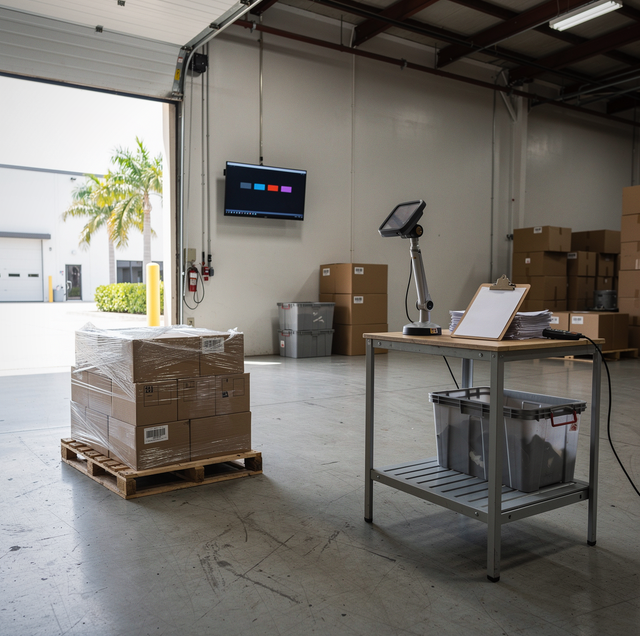
A customer places an order on a Tuesday. Your system says the item is in stock. Your warehousing partner's system says something different. Nobody catches the mismatch until the order fails to ship, and now you're refunding a customer and trying to figure out which number was ever right. That gap between what your records say and what's actually sitting on a shelf is usually not a one-time glitch. It is a sign of how the partner runs its operation every single day, and it is exactly the kind of thing a facility tour and a rate sheet will never show you.
Most businesses shopping for warehousing space compare square footage, dock count, and monthly rate, then sign. Those numbers matter, but they tell you almost nothing about whether a provider can actually protect your inventory, keep your fulfillment on schedule, and absorb a spike in volume without falling behind. The criteria below are what separate a facility that merely stores boxes from a partner that runs an operation you can build your business on.
Can You See What You Actually Own
Ask a candidate warehouse a simple question: if you called right now, how quickly could they tell you the exact quantity of a specific SKU, its location in the building, and when it last moved? A partner running a real inventory management system should answer in minutes, not by promising to "check and get back to you."
The difference between a system that tracks inventory and one that merely records it comes down to how often the count gets verified against reality. Some operations rely on periodic manual counts and update records in batches; others scan every pallet at every touchpoint, so the system reflects what's on the shelf in near real time. The second approach costs more to run, but it is why a partner can tell you about a shortage before it becomes your problem, rather than after a customer complains.
Ask, too, how discrepancies get resolved. A provider with a real process investigates a mismatch and reports the cause. A provider without one just adjusts the number and moves on, allowing the same error to recur.
Climate Control and Security Are Two Separate Guarantees
It's easy to lump "climate control" and "security" together as generic facility features, but they protect against completely different risks and deserve separate questions. Climate control protects your product from the building's environment: heat, humidity, and temperature fluctuations that can degrade packaging, warp labels, or ruin anything sensitive to moisture. Ask for the actual temperature and humidity range the facility maintains, how it's monitored, and what happens when a unit fails overnight. A vague answer here is a preview of how your goods will be handled when nobody is watching.
Security protects your product from people. That means cameras that are actually monitored rather than recording into a void nobody reviews, badge-controlled or logged access to storage areas, and a written policy for who is allowed near your inventory and when. Ask whether access logs exist and how long they're kept. A facility that treats security as a single padlock and a sign in the parking lot is telling you it hasn't thought past appearances.
Neither guarantee substitutes for the other. A climate-controlled space with unrestricted access is still a shrinkage risk, and a tightly secured building with no humidity control can still ruin sensitive goods from the inside.
What Happens When Your Volume Doubles Overnight
Every business has a busy season, a promotional spike, or an unplanned surge from a supplier, and this is where a lot of warehousing relationships quietly fail. A partner's performance during an ordinary, predictable month tells you almost nothing about how it performs when demand jumps. Ask directly: what happens to receiving times, staffing, and dock availability when a client's volume increases sharply with limited notice?
A facility built for flexibility will describe how it adds labor and dock capacity on short notice, not just where it would find extra square footage. Space is rarely the constraint; people and scheduling usually are. Ask for an example of a time when a client's volume spiked and what operational changes were made to absorb it. If the answer is a shrug or a promise that "we'd figure it out," that's a real signal about how your busiest week will actually go.
This works in both directions. A partner should also be able to describe how it handles a slow stretch, including whether you get charged for unused space and whether storage can flex down as easily as it flexes up. A provider that only talks about scaling up isn't giving you the full picture.
How Fast Goods Move From Truck To Order
Receiving, putaway, and fulfillment turnaround is the part of the operation your customers actually feel, even though they never see it. A pallet that sits on the dock for two days before it's checked in and shelved is inventory you can't sell yet, no matter what your own system says. Ask how long it typically takes from truck arrival to the item being available to pick, and ask what happens when a shipment arrives outside normal hours or without advance notice.
The same question applies on the outbound side. Once an order comes in, how long before it's picked, packed, and handed to a carrier? A provider should be able to describe a specific process, not just a general commitment to speed. Ask what the exception process looks like too: a mislabeled pallet, a partial shipment, or a rush order that needs to jump the queue. Operations that only perform well when everything goes according to plan will struggle exactly when you need them most.
Who Pays When Something Goes Wrong
Insurance and liability coverage rarely come up until there's a claim, and by then it's too late to negotiate better terms. Before you sign anything, ask what type of coverage the facility carries for goods in its care, custody, and control, and how that coverage differs from the building's general property insurance. Those are not the same policy, and a provider that conflates the two either doesn't understand its own coverage or is hoping you won't ask.
Also ask about the claims process itself: who initiates it, how long it typically takes, and what documentation you'd need to provide if a pallet were damaged or went missing. A partner with a clear, fast claims process is telling you they've handled a claim before and built a process around it. One that gets vague or defensive about claims history is a reason to slow down, not speed up.
Liability limits matter as much as the coverage itself. A policy that caps payout per shipment or per occurrence at a level far below your typical declared value leaves you exposed even with coverage technically in place. Get the specific limit in writing and compare it against what a realistic loss would actually cost you.
Red Flags Worth Slowing Down For
A few warning signs tend to show up again and again when a warehousing relationship goes wrong, and most of them are visible before you ever sign a contract.
Vague answers to specific questions are the biggest one. If you ask about temperature ranges, staffing during a volume spike, or claims history and get a general reassurance instead of a number or a named process, that vagueness usually carries into how the account gets managed once you're a client. A confident partner answers specifics with specifics.
Reluctance to provide a reference client is another. A provider proud of its operation will connect you with an existing customer, ideally one whose product and volume resemble yours. Hesitation here is worth noting on its own.
Watch for contract terms that lock you in without protecting you: automatic renewal clauses with a short window to opt out, liability caps that were never explained upfront, or rate increases with minimal notice. None of these are dealbreakers by themselves, but a contract stacked with several of them, paired with vague operational answers, tells you the partnership is built to favor one side.
Finally, pay attention to how a provider talks about capacity. A facility that claims it can handle any volume, any timeline, and any product type without describing constraints is not being reassuring; it's being unrealistic. Every real operation has limits. A partner willing to name its limits is one that has actually thought through its own operation, and that honesty is a better predictor of reliability than any promise designed to close the deal.
Weigh all of this together rather than picking one category to obsess over. A facility with excellent tracking but weak insurance still leaves you exposed. A partner with strong security but no plan for volume swings will still let you down during your busiest month. The goal isn't a perfect scorecard; it's a clear-eyed picture of where a provider is strong, where it's thin, and whether those gaps line up with what your business actually needs.
Frequently Asked Questions
Ask to be named as a certificate holder on the policy and request a certificate of insurance that specifically lists coverage for goods in the provider's care, custody, and control, separate from the property policy covering the building itself. If the certificate only shows building or general liability coverage with no mention of your inventory, that gap needs to be closed in writing before you sign.
Many well-run operations target same-day check-in and putaway for standard pallets arriving during normal hours, with a defined next-day window for irregular or oversized freight. Ask a candidate provider for their average dock-to-shelf time and treat any answer longer than a day or two, without a specific reason, as worth pushing back on.
It matters more than it sounds. Barcode or RFID scanning at each handling point creates a timestamped record whenever a pallet or case moves, while a manual count only captures a snapshot when someone walks the floor. The gap between counts is exactly where shrinkage and mis-picks go undetected the longest.
Many operations ask for thirty to sixty days' notice to line up additional labor and reserve dock time for a known seasonal spike. Volume increases sprung with little or no warning are far more likely to result in delayed receiving and slower putaway, so ask specifically what lead time a provider needs to perform at full speed.
Ask whether access to storage areas is controlled by individually assigned badges rather than a shared key, and whether entry and exit are logged and retained for a set period. Some larger operations also maintain certifications tied to supply-chain security programs; even without a formal certification, a facility that can show you a real access log is demonstrating more than one that just points at a camera.
Watch for an automatic renewal clause paired with a short-notice window to opt out, sometimes as little as 30 days before the renewal date. Combined with a liability cap that was never discussed during the sales process, this kind of clause structure is designed to make leaving harder than staying, regardless of how the operational relationship is actually going.
Schedule an operational review — walk through our inventory tracking, security controls, and claims process before you commit to a contract. Delivery and Warehousing Solutions serves West Palm Beach, Palm Beach Gardens, and Jupiter. Call (561) 842-0044.
