
What to Actually Check Before You Sign With a Warehousing Partner
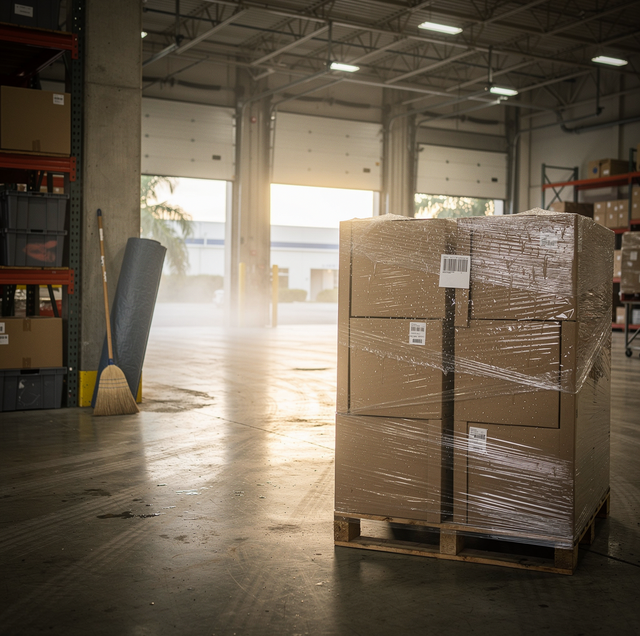
You are standing in a candidate warehouse in the middle of July, and the sales rep is talking about square footage while you're noticing something else entirely: the air feels thick. There's a faint smell of cardboard gone soft. A pallet of what appears to be packaged goods near the loading dock has a light sheen of condensation on the shrink wrap. Nobody in the room seems to have clocked it but you. That single detail tells you more about this partner than the tour script does, because it shows what happens to your product on days when nobody is watching.
This is the moment most businesses skip. They compare square footage, dock doors, and general location, sign a contract, and only learn what the partner actually does under stress once a heat wave, a storm, or a demand spike hits mid-contract. By then you're not evaluating, you're stuck. The goal of this guide is to move that evaluation earlier, before the signature, so you're choosing based on how a partner performs when conditions get hard rather than how their brochure reads when conditions are easy.
Start With What Happens When Things Go Wrong
Ask the partner directly what their plan is if a storm knocks out power for three days, if a supplier delivers a surge of inventory with no warning, or if a truck breaks down mid-route. Their answer tells you whether they've actually thought about failure or whether they're assuming things will always go smoothly.
A warehouse in a region with real storm risk needs more than a generator sitting in a corner. Ask about backup power that's tested on a schedule, not just present. Ask whether they have a written process for securing and relocating inventory ahead of severe weather, and whether they've actually activated that process before or only written it down. A partner offering emergency-response storage as a real service, not an afterthought, should be able to describe a specific instance in which they moved goods, protected them, or kept a client's operation running during a disruption. If the answer is vague or defensive, treat that as data.
This matters more than most buyers expect going in. A facility can look identical from the outside 350 days a year and only reveal its actual character on the 15 days when the weather turns. You're not paying for those calm days. You're paying for what happens on the bad ones.
How the Building Itself Handles Your Product
Climate control sounds like a checkbox on a spec sheet, but it's really a question about physics. Heat and humidity don't just make a warehouse uncomfortable to walk through; they degrade packaging, warp labels, encourage mold on porous materials, and can quietly ruin anything sensitive to temperature swings, from electronics to food-adjacent goods to certain raw materials. If a facility sits in a hot, humid climate and doesn't treat climate-controlled storage as a serious operating requirement, your inventory is absorbing that risk every single day it sits on the shelf.
Don't just ask if they have climate control. Ask what the target humidity and temperature ranges are, how those ranges are monitored, and what happens when a unit fails at 2 a.m. on a Saturday. A facility that can answer with specifics, sensor logs, alert thresholds, and maintenance schedules is telling you climate control is a system they manage, not a feature they installed once and forgot about.
There's a similar consideration if your goods are anywhere near coastal air. Salt and moisture in that kind of environment work on metal fasteners, electronics, and packaging the way slow rust works on an old fence: you don't see the damage happening, you just see the result months later. If your products or their packaging include any metal components, ask how the facility protects against corrosion, not just heat.
Ask How They Handle A Volume Spike
Here's the analogy worth keeping in mind: choosing a warehousing partner is a lot like choosing a bridge. You don't test a bridge by driving a sedan across it once. You need to know what it does under the heaviest truck it will ever carry, because that's the day it actually matters. The same logic applies to a warehousing partner. Their performance during a normal, predictable week tells you almost nothing about how they'll perform during your busiest season, your biggest promotion, or an unplanned shipment surge from a supplier.
Ask what cross-docking capability actually looks like at this facility, not in theory but in practice. Cross-docking, moving goods from inbound to outbound with minimal storage time in between, only works if a partner has the staffing and dock scheduling to execute it under pressure, not just the physical layout for it. Ask how they've handled a client's demand spike before, what broke, and what they changed afterward.
Also ask how transportation and logistics management fits into their operation versus how it's handled by a separate vendor they coordinate with. A partner managing storage and the movement of goods under one roof can generally respond to a schedule change faster than one juggling handoffs between separate companies. Fewer handoffs means fewer places for a shipment to get lost in translation. And ask specifically about final-mile delivery capability if that's part of what you need. Not every partner offering broad warehousing services actually runs final-mile well; some treat it as a bolt-on rather than a core competency.
Find Out How They Track What You Own
You should never have to call a warehousing partner and wait a day to find out how much of your product is actually on their shelves. Inventory auditing and tracking is the single most concrete thing you can test before you sign, because it's the one capability you can verify with a direct question and a direct demo rather than a promise.
Ask how often physical counts are reconciled against system records, and ask to see what a status report actually looks like, not a marketing mockup of one. Ask what happens when a discrepancy turns up: is there a set investigation process, or does it just get adjusted quietly in the system with no explanation to you? A partner confident in their tracking will show you the report format without hesitation. One that hedges or changes the subject is telling you something too.
This is also where you should ask about audit frequency for slower-moving inventory specifically. It's common for tracking systems to stay accurate on fast-turning goods and drift on anything that sits for months, since fewer transactions mean fewer chances to catch an error. Ask how they catch drift on the items that don't move often.
Match Their Warehousing Model To Your Business
Not every warehousing partner is built the same way, and the differences matter more than most contracts make obvious. Some are set up primarily to serve manufacturers who need a facility to hold raw materials and finished goods between production runs. Others are built around general 3PL client mixes with a wider variety of product types and shipping patterns. Ask which model actually describes the partner you're evaluating, and ask them to point to a client whose operation resembles yours in scale and product type.
If your need is occasional rather than constant- a product launch, a trade show, a renovation displacing your current storage, a seasonal overflow- ask specifically about project and event storage. This is a different service from ongoing warehousing, with different flexibility requirements, and a partner should be able to clearly tell you whether they offer short-term, defined-window storage as a real offering or will try to fit you into a standard long-term contract that doesn't match your actual needs.
Look At How They Communicate Before A Problem, Not After
Every warehousing partner sounds responsive during the sales process. The real test is what their communication looks like once you're a client dealing with something ordinary, a delayed shipment, a question about a discrepancy, a request to check on a specific pallet. Ask for a reference client and ask that client, specifically, what it's like to reach someone when something needs attention outside normal business hours.
Ask who your actual point of contact will be day-to-day, not just who signed the contract. A partner with a named contact who understands your account tends to catch small problems before they become expensive ones. A partner that routes every question through a general inbox is telling you communication isn't built into how they operate; it's something that happens if you push for it.
None of these criteria work well in isolation. A facility with excellent climate control but no real disaster plan is still a risk in a storm-prone region. A partner with strong tracking but poor communication will still leave you discovering problems late. Weigh them together, and weight climate control and emergency-response capability more heavily than most buyers do at first, since those are the two categories most often glossed over during a tour and most painfully felt months later when conditions turn against you.
Frequently Asked Questions
Give yourself at least two to three weeks if possible, since a proper evaluation includes a facility walk-through during business hours, a reference call with an existing client, and a written response to specific operational questions, not just a same-day quote. Rushing this process is exactly how buyers end up focused on square footage and pricing structure while missing storm readiness or tracking gaps.
Ask the reference how a specific past problem was resolved, not whether they're satisfied overall. Satisfaction questions get polite answers. Asking "tell me about a time something went wrong and how they handled it" tends to surface the honest texture of the relationship, including response times and whether the partner owned the issue or deflected it.
A virtual tour can't tell you what the air feels like, whether there's condensation on stored goods, or whether the loading dock area smells like anything is degrading. Humidity and moisture issues are often detectable within minutes of walking a floor but nearly invisible on camera, so an in-person visit is worth the trip if your goods have any sensitivity to climate at all.
Ask for the date it was last tested or activated, not just whether one exists. A plan that's never been run through a drill or an actual event is closer to a document than a capability, and a partner who can describe a specific date and outcome is showing you evidence rather than intention.
Ask each partner for their average dwell time, meaning how long goods typically sit between inbound arrival and outbound departure during cross-docking. A shorter, consistent dwell time under real operating conditions is a better signal than a description of the process, since it reflects actual staffing and scheduling discipline rather than a capability that exists mostly in theory.
Ask how they notify the end customer about delivery windows and how they handle a missed appointment, since final-mile success is judged by the person receiving the goods, not just by whether the truck left on time. A partner who can describe their appointment-scheduling and re-delivery process has clearly run into the problem before and developed a way to handle it.
Schedule a facility walk-through — see how our climate control, inventory tracking, and storm readiness actually work before you sign. Delivery and Warehousing Solutions serves West Palm Beach, Palm Beach Gardens, and Jupiter. Call (561) 842-0044.
