
Storm season does not wait for a business to get organized. By the time a named system shows up on a forecast map, the window for careful prep work has usually closed, and what's left is rushed decisions made under pressure. The businesses that come through storm season with the least damage are almost never the ones scrambling in the final 48 hours. They're the ones who treated inventory protection as a seasonal routine rather than a one-time emergency response.
Preparing warehoused inventory ahead of storm season is not complicated, but it does take planning across several fronts at once: physical placement of goods, protective materials, backup power, and paperwork. Skip any one of those, and a storm can turn a manageable disruption into a serious loss. Here's how to work through each piece before the season builds.
Start With A Realistic Inventory Risk Assessment
Before moving a single pallet, walk your storage space and categorize what's inside by vulnerability. Not every product carries the same risk. Paper goods, electronics, textiles, and anything with cardboard packaging absorb moisture fast and can be ruined by humidity alone, long before any actual flooding occurs. Sealed plastic containers and metal goods tolerate a wet environment far better.
Group inventory into rough tiers: high-risk items that need to move first and get the most protection, moderate-risk items that need covering but can wait, and low-risk items that need little more than a stable location. This sorting exercise takes an afternoon and saves hours of guesswork once a storm is actually approaching. It also tells you where your protective materials and labor should go first, rather than spreading effort evenly across the entire building regardless of what's actually vulnerable.
While you're walking the space, note which sections sit closest to loading doors, low windows, or any point where wind-driven rain could get in. Those zones deserve extra attention even if the products stored there aren't inherently moisture-sensitive.
Get Every Pallet Off the Floor
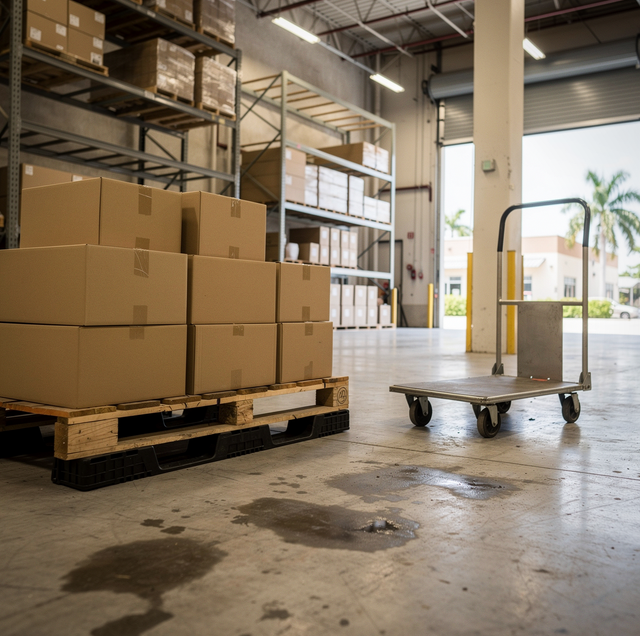
Floor-level storage is one of the most common and most preventable causes of storm-related inventory loss. Water finds its way into buildings in ways that are hard to predict: a failed door seal, a roof leak overwhelmed by sustained rain, or groundwater pushed up through a slab during sustained downpours. None of that requires a direct flood event to soak the bottom layer of goods sitting on the ground.
Raise pallets by four to six inches using pallet risers or racking, and treat it as a year-round baseline rather than a seasonal fix you apply and remove. Anything currently sitting directly on the floor should be addressed first, regardless of how sensitive its contents are. Even sealed containers can end up sitting in standing water long enough to develop mold on the exterior, which complicates handling and resale even when the product inside stays intact.
For inventory that's especially valuable or hard to replace, go beyond the minimum and place it on the highest available shelf. Gravity is doing a lot of the protective work here, and it costs nothing beyond the labor to move things.
Protect Moisture-Sensitive Goods With the Right Wrapping and Covering
Once inventory is off the floor, the next layer of defense is what's wrapped around it. Shrink wrap alone is designed to stabilize a pallet during transport, not to keep out sustained moisture, so it should not be treated as a storm barrier on its own. For anything paper-based, electronic, or otherwise moisture-sensitive, add a waterproof tarp or heavy plastic sheeting over the wrapped pallet, secured well enough that wind from an open dock door won't pull it loose.
Pay attention to the materials themselves. Corrugated cardboard boxes wick moisture upward from the bottom if they sit near dampness, so a waterproof layer between the pallet and the floor matters as much as the top covering. If you have the option, consolidate your most sensitive inventory into a single, easily monitored section of the building rather than leaving it scattered across multiple aisles. That makes it faster to check, cover, and move if conditions change.
Keep desiccant packs or moisture absorbers on hand for enclosed containers and sealed totes. Humidity that builds up inside a sealed container during a power outage can do as much damage as an actual leak, particularly to anything with adhesive components, printed materials, or electronics.
Plan for Power Loss Before It Happens
Climate-controlled storage only protects inventory as long as the climate control keeps running. A prolonged outage during storm season can undo weeks of careful temperature and humidity management in a matter of hours, especially for goods that are sensitive to heat, cold, or condensation. Backup generator capacity sized for your actual storage footprint, not just your office or administrative space, needs to be part of the plan well before storm season arrives.
Test backup power systems on a schedule, not just when a storm warning appears. A generator that hasn't been run in months is a real liability, and fuel supply needs to be confirmed and refreshed regularly rather than assumed. If your operation relies on a third-party facility for climate-controlled storage, confirm directly what backup power capacity exists, how long it can run unattended, and what triggers a fuel resupply during an extended outage. Vague assurances aren't a substitute for a specific answer.
For temperature-sensitive inventory that can't tolerate any gap in climate control, identify in advance whether relocating to a facility with confirmed generator redundancy is feasible if an outage lasts longer than expected. Knowing that answer ahead of time is far better than researching it mid-crisis.
Build A Documentation Trail Before the Storm, Not After
Insurance claims move faster and pay out more accurately when there's a clear record of what existed before a loss. Photograph and log your inventory, including quantities, storage location, and approximate value, on a regular basis, and update that record specifically before storm season peaks. A dated photo of a fully stocked section of your warehouse is worth far more to a claims adjuster than a memory of what was probably there.
Keep this documentation somewhere it will survive a power outage or on-site disruption. Cloud storage, off-site backups, or a physical copy kept away from the storage facility itself all work, provided the information isn't stored on a single device inside the building that might lose power or be damaged. Include your storage provider's contact information, any service agreements, and coverage details in that same package so everything's accessible from one place if you need to file a claim quickly.
Review your coverage limits against your actual current inventory value at least once before storm season starts. Coverage that was adequate a year ago may not reflect current stock levels, and finding that gap after a loss rather than before it is a costly way to learn.
Create A Simple Storm-Response Checklist Your Team Can Follow
Individual precautions only work if the people handling inventory know exactly what to do and in what order. A short, written checklist that covers elevation, covering, power checks, and documentation removes the guesswork when a storm is actually approaching and everyone's under time pressure. Assign specific tasks to specific people rather than leaving the whole list as a shared responsibility that no one owns.
Run through the checklist at least once before the season starts, treating it like a drill rather than a document that sits in a drawer. Walking the actual process, even briefly, surfaces gaps that reading a list on paper never will: a locked supply closet, a missing key, a generator that won't start on the first try.
Update the checklist based on what you learn from each storm season. If something took longer than expected or a step got missed, that's information worth building into next year's version rather than repeating the same scramble annually.
Know When to Move Inventory Off-Site
Not every storm calls for full evacuation of stored goods, but some do, and knowing the difference in advance saves time when it counts. Set clear internal thresholds ahead of time, tied to storm intensity, projected duration of an outage, or the specific vulnerability of your building, rather than making that call in the moment based on incomplete information.
If off-site relocation becomes necessary, having pre-arranged access to secure, climate-controlled space with reliable backup power removes a huge amount of pressure from an already stressful situation. Arrangements made in advance, before demand spikes and options narrow, tend to go far more smoothly than anything negotiated after a storm is already forecast to arrive within days.
Frequently Asked Questions
A minimum of four to six inches is a reasonable baseline for most warehouse floors, though higher is better for anything especially valuable or hard to replace. Racking or upper-level shelving offers more protection than floor-level risers alone.
No. Shrink wrap stabilizes pallets for handling and transport, but it isn't designed to keep out sustained moisture. Moisture-sensitive goods need an additional waterproof tarp or heavy plastic covering, secured tightly enough to withstand wind.
Test on a regular schedule year-round, not just when a storm warning appears. Confirm fuel supply and resupply plans at the same time, since a generator that hasn't run in months is an unreliable safety net when it's actually needed.
Dated photos and logs showing inventory quantities, storage location, and approximate value, taken before any loss occurs, give claims adjusters something concrete to work from. Store that documentation somewhere it will survive a power outage or on-site disruption.
Set internal thresholds in advance, based on storm intensity, expected outage duration, and your building's specific vulnerabilities. Having that decision made ahead of time, rather than during the storm itself, prevents rushed and often costly choices.
Review and adjust it after every storm season based on what actually happened: steps that took longer than expected, gaps in access, or equipment that didn't perform as planned. Treating the checklist as a living document keeps it useful rather than outdated.
Schedule a storm-readiness storage review — get climate-controlled space, backup power, and secure documentation support in place before the next storm system builds. Delivery and Warehousing Solutions serves West Palm Beach, Palm Beach Gardens, and Jupiter. Call (561) 842-0044.