
Fragile or High-Value Freight? What Specialized Storage Adds
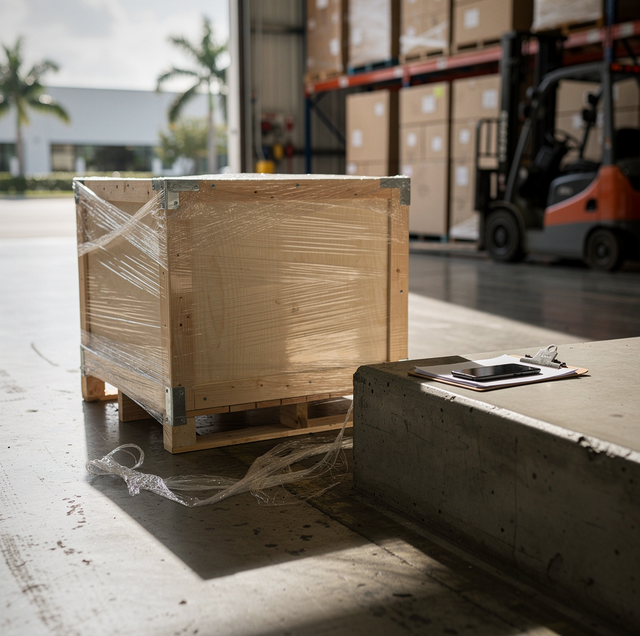
A standard rack-and-forklift operation is built to move volume. A trailer backs in, a lift truck pulls pallets off, a scanner ties the pallet ID to a location, and the freight sits in a beam bay until someone picks it. Every step is tuned for cube and throughput, and for most packaged goods it works.
Change one variable and the sequence stops fitting. Put laminated glass panels, a calibrated instrument, or a machine skid on that same pallet, and the equipment is identical, while the assumptions underlying it are not. Fragile freight fails at accelerations a lift truck produces without effort. High-value freight fails commercially rather than physically: one missing carton out of forty matters more than a scuffed corner on a pallet of paper towels. Specialized storage is not a different building. It is a different set of decisions at the six points where freight gets touched.
| Handling point | Standard pallet | Fragile or high-value pallet |
|---|---|---|
| Receiving | Count against the purchase order | Condition inspection, exceptions noted at the dock |
| Handling | Fewest touches for labor cost | Fewest touches for risk, and the unit of movement changes |
| Storage position | Any open bay that fits | Single-deep, nothing stacked above, out of traffic |
| Access | Open aisles, any picker | Named access list, custody log at each transfer |
| Staging | Built early, parked in the dock apron | Built late, into a marked area off the travel path |
| Condition record | Signature on the receipt | Dated images and a defect report at each step |
Receiving and Inspection Decide What You Can Prove Later
Standard receiving answers one question: Did the right number of the right items arrive? A checker counts, scans, signs the delivery receipt, and the driver pulls out. Damage found three days later has no owner because nothing in that sequence separates the harm done on the truck from the harm done in the building.
Fragile receiving answers a second question first: What condition did it arrive in? Stretch wrap comes off in the receiving bay rather than in the rack, because it hides crushed sidewalls and shifted cartons well enough to survive a walk-past. Crate faces are photographed before a fork goes under them, and any indicators the shipper applied are read.
Those indicators reward understanding rather than a glance. An impact indicator is a spring-loaded mass held against a calibrated resistance; past the device threshold, the mass travels far enough to latch a red flag, and it cannot be reset without breaking the housing. A tilt indicator does the same with a steel ball and a gravity path. Neither proves the goods are broken; both prove the package saw an event its packaging was not built to absorb, which is the cue to open and inspect.
A tripped impact or tilt indicator is not proof of damage, and not grounds to refuse a load. Note its number and reading as an exception on the delivery receipt, then open and inspect that piece before the driver leaves.
Physical Handling and Packaging Change the Unit of Movement
Every touch is an opportunity for damage, and standard operations already minimize touches for labor cost rather than for risk. Start with the pallet under the load. Most warehouses accept a pallet with a cracked deck board, because a stack of cartons spreads the load and nobody notices. Under a crated instrument or a stone slab, that same cracked board lets a tine lift unevenly and drives a point load through the crate floor. Fragile freight is often re-palletized onto a sound four-way pallet, load-centered.
Then the restraint. Stretch wrap holds cartons against sliding, but it pulls inward and does nothing for vertical stability. Corner boards under the wrap turn four lines of film tension into four vertical columns, and banding over them stops the stack racking sideways during a fast turn. Irregular items go into a crate with internal blocking so nothing contacts the crate wall. Inside the carton, the same logic runs at a smaller scale: void fill prevents contents from shifting, and a foam-in-place or double-boxed part is suspended off the outer wall so that an impact dissipates in the cushion rather than in the item.
Attachment choice changes the failure mode outright. A carton clamp squeezes, and on anything with a rigid frame or a hollow void, the squeeze is what breaks it. Slabs ride A-frames. Drums move on a drum handler, not bare forks. Speed is a control too: heavy or unstable freight is a struck-by hazard for anyone in the aisle, so these pallets travel low and slow, often with a spotter walking the path.
Storage Environment and Racking Carry the Static Load
Temperature and humidity control is a product question, settled by the commodity itself long before handling comes up. A controlled room is only part of a storage position; the rack and the surrounding neighbors do the rest.
Rack type drives the impact rate more than anything else in the building. Drive-in racking puts a lift truck inside the storage lane, with the mast, the load, and the operator sightline all working in a space narrower than an aisle, so contact with an upright is routine. Selective racking keeps the truck in the aisle and reaches in, so nothing enters the bay except forks. Fragile freight belongs in single-deep selective positions, or on marked floor positions with the space above kept empty.
Capacity is the part most operations read wrong. A beam capacity plaque states a rating per beam pair at a given spacing, and that rating assumes the load is evenly distributed across both beams. A machine base resting on two small feet drives most of its weight into two short spans and can overload a beam pair rated well above the item's total weight. Frame capacity also depends on the first beam elevation, so raising a bottom level without rechecking the chart can put the frame over its rating.
Never reposition a beam level or reach a loaded fork into a bay while anyone stands in the aisle below. Powered industrial truck operation and high-rack work are trained-operator activities, and a shifting load is a crush hazard.
Access Control and Chain of Custody Narrow Who Touches the Freight
Loss and damage resolve to the same question: who had the freight, and when. A standard warehouse cannot answer that in detail and does not need to. Aisles are open, any picker walks any lane, and the record shows a location and a quantity, not a person and a time.
High-value storage narrows the population. The physical side is a caged area, a separate room, or a fenced block of positions with a keyed or badge-locked door and an access list maintained by a supervisor. Some operations add a two-person rule, so nobody enters alone, and no single account is the only account of what happened.
The system side matters as much. The location gets flagged restricted in the warehouse management system, so ordinary replenishment and pick logic will not route work there, and movement in or out takes a specific transaction with a user ID attached.
Between the two sits the custody log. Every transfer of the pallet gets a line: date, time, released by, received by, signature. Numbered tamper-evident seals make that log verifiable: the seal number is recorded at each hand-off, so a break in the chain points to one leg of the movement rather than the whole stay.
Staging and Release Concentrate the Handling Risk
Freight that sat untouched for six weeks is suddenly moved, re-wrapped, driven across the building, set down near a door, and loaded. More handling happens in that hour than in the whole storage period, on the busiest floor in the building.
Standard practice is to build orders early and park them on the dock apron so loading is quick. For fragile freight, that trade runs the wrong way. A staged pallet in the apron sits in the travel path of every other order going out that shift, and each pass is a chance for a tine to catch a corner. Staging late, into a taped-off area set back from the door, cuts the exposure window from hours to minutes.
Release is a verification point, not just a hand-off. Outbound count and condition are checked against the receiving record, the pallet is photographed again, and a second person signs. Short-term staging built around a project or an event runs on its own schedule, planned around the delivery date.
Loading is the last controlled moment. The trailer floor is inspected for broken boards and protruding hardware; the trailer is restrained, and the load plan places the fragile pallet against a bulkhead with load bars behind it. Once the doors close, restraint and route handling take over from storage practice.
Documenting Condition Turns Handling Into a Record
An inspection nobody wrote down is an opinion. A condition record narrows the window in which damage happened, which is how a claim or a supplier conversation ever resolves cleanly.
A usable record has three properties. It carries a timestamp, so an image sits on one side or the other of a specific movement. It is tied to the unit rather than the shipment, so the crate or pallet ID visible in the photo also appears on the custody log and on every transaction touching that location. And it uses consistent defect language, so that "crushed lower corner, left face, banding intact" means the same thing to the receiving clerk, the operations manager, and the shipper.
The practical shape is simple. Images at receiving, before the wrap comes off and after. Images at any handling event that was not routine, such as a repack. Images at release, from the same faces so the two sets compare directly, with a short condition report that names defects rather than describes them. Insurance sits alongside this rather than replacing it: coverage is a question to put in writing to a warehouse before the first pallet arrives, and a condition record keeps that conversation brief.
Frequently Asked Questions
Ask for the packing list and bill of lading ahead of the truck so receiving can verify piece counts without opening the whole load, and confirm how that carrier handles an OS&D report, the over, short, and damaged form that records an exception. Carriers commonly expect concealed damage to be reported within a few business days, so knowing that window sets the timeline for the inspection.
Look for the box maker's certificate, the round stamp printed on the bottom flap of a corrugated carton. It provides either an edge crush test rating in pounds per inch or a bursting strength in pounds per square inch, along with a maximum gross weight and size limit. A 32 ECT stamp is a common single-wall grade; heavier or more valuable contents call for double wall or a rated crate rather than more tape.
Considerably. Most of a corrugated box's compression strength lives in its four vertical corners, so a column stack, corners landing directly on corners, carries far more than an interlocked or pinwheel pattern that sets an upper corner on a lower box's unsupported panel. Interlocking buys stability against toppling and gives up stacking strength, which is why fragile stacks are column stacked with corner boards.
Either on a marked floor position with the space above it empty, or in the golden zone, the band running roughly between knee and shoulder height, about 30 to 60 inches off the floor. A pallet there is worked without a stoop or an overhead reach, and case picks involve a short lift instead of a lift and a lower. That band also keeps fragile items off the top beam levels, where every case pick needs a lift truck and a raised mast.
More often than the rest, and by a different method than a rotating schedule. High-value positions are usually counted on each access rather than on a calendar, so the count is tied to the custody log entry, and any discrepancy has one movement attached to it instead of a month's worth. Some operations also count toward the seal number rather than the piece count when the seal is intact, and only count toward the piece count when it is open.
Ask which kind of policy is in place, since warehouse legal liability coverage and all-risk cargo coverage respond differently and are not interchangeable. Ask how limits are stated, per occurrence or per pallet, whether your commodity sits on an exclusion schedule, and whether a declared-value process exists above the standard limit. Get those answers in writing and check them against your own broker.
Walk your fragile and high-value SKUs through a handling review before the next inbound load — you get a written receiving, storage, and release plan instead of hoping the pallet survives. Delivery and Warehousing Solutions serves West Palm Beach, Palm Beach Gardens, and Jupiter. Call (561) 842-0044.
