
A Slip Sheet in Place of a Pallet, and When It Works
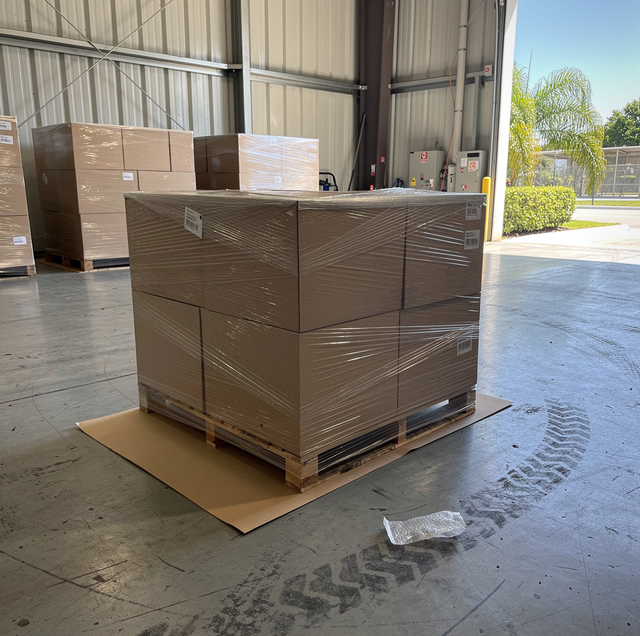
Forty thousandths of an inch is all that sits between the bottom carton and the concrete. The load came off the trailer shrink-wrapped and square, four feet of product standing on a footprint of forty by forty-eight inches, and underneath it there is no wood at all. There is a laminated kraft sheet with a three-inch lip standing proud along one side, waiting for something to grab it. From the top, the load looks like every other load on the dock. The whole difference sits underneath, and it decides which trucks can pick the load up, how many loads fit in a bay, and what happens the fourth time somebody moves it. That last question is the one your operation is really asking.
Slip Sheets Put the Load on Hundredths of an Inch
A slip sheet is that kraft sheet: a flat base, no thicker than a few playing cards, that your product is stacked and wrapped directly onto. It carries the same plan dimension as the load above it and has one or more lips, called tabs, running along the sides of the product where a truck will engage it. No deck, no stringers, no blocks.
The thickness figures are published in the patent record, and they are small. US Patent 4,708,247, granted in 1987, specifies a slip sheet thickness of 0.025 to 0.090 inches. US Patent 5,881,651, granted in 1999, gives a range of about 0.015 to 0.080 inch and calls 0.040 to 0.060 inch the preferred band. Both describe the same object: laminated kraft board or polyethylene, thin enough that the load's height is essentially the unit's. The lip is the part that does the work, and both patents size it the same way. The 1987 patent describes tabs extending about three or four inches beyond the load, and the 1999 one puts the desired tab depth at about four inches.
How many tabs a sheet gets is a design choice, and a national industry standard that covers these bases treats it as such, giving a full section on slip sheets and illustrating one-tab, two-tab, three-tab, and four-tab designs alongside corner cutouts and slit corners. A one-tab sheet can be engaged from exactly one side. A four-tab sheet can be engaged from any of them, and every extra tab is more board hanging past the product.
So the object under your load is a surface with a handle on it. Everything that follows comes out of that fact.
Both Ends of the Lane Have to Own the Same Attachment
Plain forks cannot pick up a slip-sheeted load. US Patent 5,881,651 provides the reason: the standard fork of such a vehicle would likely penetrate the stretch-wrapped bales. There is nothing to slide the tines under. What handles it is a push-pull attachment, which the same patent describes as a flat horizontal platen with a vertical faceplate that travels along it, ending in a gripper.
The gripper jaws clamp the tab, the platen slides under, and the whole unit load is dragged onto the platen by its own three-inch lip. Setting down runs backward, with the faceplate pushing the load off. That hardware changes what your truck can lift. US Patent 4,828,450, granted in 1989, says the added weight of the attachment reduces the net load capacity of the truck, and that attachments cut it a second way by shifting the load's center of gravity forward, an effect it names lost load or effective thickness.
That reduction shows on the truck's own plate. The safety standard for these trucks requires the nameplate to carry the capacity of the truck and attachment combination at full lift height, with the load laterally centered, and a removable attachment to carry a plate reading, in capitals, that the combination may be less than the capacity shown on the attachment. So the question a slip sheet really asks is which docks in your lane own a push-pull truck, because a sheeted load arriving anywhere else is one your consignee cannot move.
The Inches a Pallet Occupies Repeat at Every Level
Measure the deck height of the pallets you actually run, because that number is yours. A national pallet standard caps the distance from a pallet's bottom surface to the top of its fork opening at 156 millimeters, about 6.1 inches, with the top deck above that. Call your pallet six inches and run it through a rack bay. An upright with 240 inches of usable height, holding a 50-inch load plus six inches of beam and clearance, needs 62 inches of pitch per level. Three levels fit. Four would want 248.
Put a sheet under the load instead of a pallet, and the pitch drops to 56 inches, so four levels fit inside 224. One upright, one more position, and the product never changed. The weight comes off as well. A published pallet-strength comparison weighed six 48-by-40-inch pallet types: five between 40.24 and 50.3 pounds and a new pallet at 50 to 60 pounds. That is forty to sixty pounds under every load in your trailer that no customer ordered.
Every Pull Runs Through the Same Three Inches of Board
A pallet is engaged from underneath, and your forks take the load through the whole deck. A slip sheet is engaged at one edge, and the whole mass of the load comes through the strip of board the gripper holds. Three or four inches of tab, clamped along one line, moving freight in the thousands of pounds.
That is why the tab is where the engineering went. The 1999 patent's contribution is a tab canted upward with a convex airfoil cross-section, so the jaws find it on the approach. Every pull works that same strip again, and a tab that has been creased, soaked or torn is a tab your gripper can lose partway through the drag.
Count the touches before you count anything else. A load that goes plant, trailer, receiving, rack, pick face, and outbound is engaged six times, and a one-tab sheet has to present the same edge at all six with the tab intact. A pallet with four-way entry gets taken from whichever side is open, which is why the two separate on handling count.
Where the Sheet Fits and Where the Pallet Stays
Slip sheets suit lanes short on touches and controlled at both ends. A plant shipping into one distribution center it owns. A container stuffed at origin and stripped at a building with a push-pull truck. A dedicated run where the same two docks handle the freight every week. Few handoffs, known equipment, and a sheet earns its place.
Pallets stay where the load will be broken down, racked, picked, split, or handed to a dock you do not control. Anything moving to a consignee you have never met is a pallet load, because the sheet's premise is equipment waiting at the far end.
A warehouse partner takes that transition off you: the sheeted load goes onto a pallet at receiving and lives on wood from there. That transfer is worth planning around because a pallet is a structure the load rides on, and a slip sheet is a surface the load is dragged from; the second needs a clear run of floor in front of it before anyone can touch it.
Frequently Asked Questions
Solid or laminated kraft board is the more common one, and polyethylene sheet is the other choice. Patent filings list thicknesses ranging from 0.015 to 0.090 inches across both materials, so what sits under your load is closer to heavy card stock than to anything structural. The choice between board and plastic usually depends on what the base of your load will sit on.
When both ends already run a push-pull truck and the load will be handled only a few times. If you ship into one distribution center you control, or stuff and strip containers at the same building, the equipment question answers itself. If your freight lands at a dock you have never walked, the sheet becomes somebody else's problem the moment the trailer doors come open.
It needs a way to be set down and picked back up, and plain racking does not provide that on its own. Most operations transfer the load to a pallet at the receiving dock and then rack it normally. Palletless racking systems exist, but they are a change to your rack rather than a change to the sheet itself.
Sometimes, and the tab decides it. The body of the sheet survives a drag well enough, but the three or four inches the gripper clamps take the whole load in tension every time. Inspect the tab for creasing, delamination, and tearing before you put a sheet back into your rotation, and retire it the moment your jaws start slipping on it. A thicker sheet gives the tab more to hold.
It is transferred, either by hand or by machine, onto something a fork can enter. Crews drag the sheet onto a pallet with a strap or a winch plate, or else break the load down carton by carton and rebuild it. Both are slow, and both happen on your clock at the receiving end, which is why the attachment question belongs in your lane design.
Whoever lifts the load is the one who owns it, because the attachment bolts onto a forklift carriage and never travels with your freight. That means you can fit out your own dock and still ship a load that nobody at the other end can handle. Ask your receiver what their trucks are carrying today before you commit a lane to sheets.
Have your inbound loads measured before a lane moves to slip sheets — sheet size and tab depth get specified to the exact footprint your product actually ships on. Delivery and Warehousing Solutions serves West Palm Beach, Palm Beach Gardens, and Jupiter. Call (561) 842-0044.
