
What Goods Require Climate-Controlled Storage?
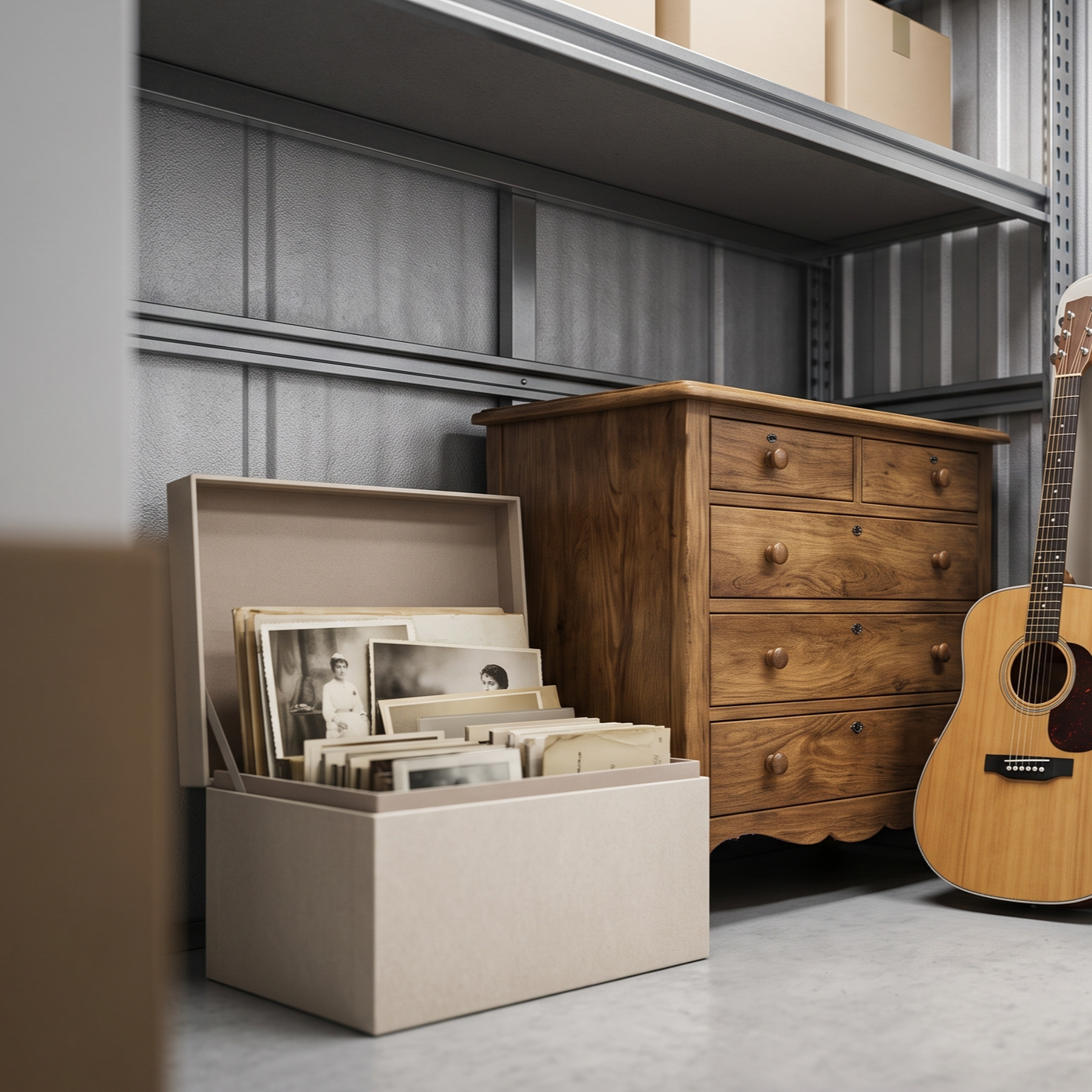
You are about to put a load of belongings into storage, and the cheaper standard unit is tempting. Then you picture the wooden dresser, the boxes of photos, and the guitar sitting in a metal box through a long, hot, humid stretch, and you start to wonder what you will find when you open that door months from now. For some items, the answer is nothing good.
Climate-controlled storage is not about pampering your things. It is about protecting the ones that heat and humidity truly damage, and knowing which those are keeps you from a costly surprise later.
What Heat and Humidity Actually Do
Two forces do the damage in an uncontrolled unit: temperature and moisture. Heat softens, warps, melts, and accelerates the chemical breakdown of materials, and large temperature swings cause materials to expand and contract until they crack, split, or loosen at the joints. Humidity is the sneakier one. Moisture in the air settles into porous materials and feeds mold and mildew, rusts metal, cups and swells wood, curls paper and photographs, and clouds or spots finishes. In a warm, damp climate, both forces run at full strength for months at a time, so the question is not whether they act, but which of your belongings cannot take it.
The Items That Really Need It
Some things tolerate a hot unit fine. Others degrade quietly until they are ruined. These are the categories worth protecting.
| Item | What heat or humidity does |
|---|---|
| Wood furniture and antiques | Warps, cracks, and loosens at the joints as it swells and dries |
| Leather goods | Dries and cracks in heat, grows mildew in humidity |
| Electronics | Moisture corrodes circuits; heat degrades components and batteries |
| Photos, documents, artwork | Curl, stick together, fade, and grow mold |
| Musical instruments | Wood and strings warp and detune; finishes craze |
| Vinyl records and media | Warp in heat, and cases mildew in damp |
| Metal items and tools | Rust and corrode in humid air |
| Wine and delicate collectibles | Heat spoils wine; swings degrade fragile materials |
The pattern is easy to see: anything wooden, anything paper or fabric, anything with electronics or metal, and anything fragile or irreplaceable belongs in a controlled environment. Sturdy plastic bins of yard tools or patio furniture usually do not.
Why the Local Climate Raises the Stakes
In a warm, humid climate, the case for climate control is stronger than in almost any other. The heat is not a summer visitor that leaves; it is close to year-round, and the humidity rides along with it, so a standard unit spends most of the year in exactly the conditions that grow mold and warp wood. Add storm season, when moisture and swings spike, and belongings that might survive a mild climate in a plain unit are at real risk here. For anything you would be sorry to lose, controlled temperature and humidity is not an upgrade in a warm, humid climate so much as the baseline that keeps your things intact.
How to Decide What Goes Where
The simplest way to sort your load is to ask two questions of each item: would I be upset to lose it, and is it made of something that heat or moisture attacks? If the answer to both is yes, it belongs in climate control. Wood, leather, paper, fabric, electronics, metal, and anything sentimental or valuable clear that bar. Concrete, hard plastic, and weather-rated outdoor gear generally do not. Sorting the load this way lets you protect what needs it without paying to climate-control a box of garden hoses.
Pack Sensitive Items the Right Way
Climate control does the heavy lifting, but how you pack still matters. Keep boxes and furniture up off the concrete on pallets or boards, since floors are where any stray moisture collects first. Cover furniture with breathable cloth or moving blankets rather than sealing it in plastic wrap, which traps humidity against the surface and can grow mildew even in a controlled unit. Use sturdy boxes for paper and photos, and add a few desiccant packs to boxes of electronics or documents for extra insurance against moisture. Leave a little airflow between items rather than packing the unit wall-to-wall. Good packing and a controlled environment together are what keep the sensitive things pristine over a long stay.
Frequently Asked Questions
A true climate-controlled unit is a conditioned space: it heats and cools to maintain roughly 55 to 80 degrees and, more importantly, keeps relative humidity in the 35 to 55 percent range, where mold spores stay dormant and wood holds its moisture. A vented or dehumidifier-only unit just skims some moisture off the air without controlling temperature, so it still swings with the weather and rides through the dew point on humid nights. Below about 35 percent, dry-sensitive items like wood and leather can crack from the other direction, which is why a controlled space targets a middle range rather than the driest possible air.
Yes, and the damage is often caused by the condensation cycle rather than by steady humidity. When a warm unit cools overnight, air hits its dew point and moisture beads on cold metal inside the device, then evaporates by afternoon, and that daily wet-dry cycle is what corrodes solder joints and edge connectors. Lithium-ion batteries add a second reason: heat above roughly 90 degrees accelerates their self-discharge and permanent capacity loss, so a laptop or power tool left in a hot unit can come back with a battery that no longer holds a charge, even though the device powers on.
Often not, and solid wood suffers most because it moves across the grain, not with it. A tabletop or panel can swell and shrink by a fraction of an inch across its width as humidity cycles, and older pieces built with hide glue are especially at risk since that glue softens and lets go above roughly 70 percent humidity, so joints and veneer separate. Veneered and laminated pieces fail differently: the thin face layer bubbles or peels as the substrate beneath it moves at a different rate. A controlled unit protects both by keeping the wood at a steady moisture content instead of letting it breathe in and out with the weather.
It can be, depending on the season and what you are storing. A few months spanning the hottest, most humid stretch of the year is enough to grow mold on leather or warp an instrument. For short-term storage of durable items, a standard may be fine; for sensitive belongings, even a few months in the wrong conditions can do lasting harm.
Durable, weather-rated things do not: sealed hard plastic bins, coated metal shelving, patio and garden equipment, and oiled tools. For borderline items in a standard unit, a desiccant like silica gel or a moisture-absorber bucket buys some protection, but it has a hard ceiling: it only pulls down the air inside a sealed container or a small closed space, it saturates and stops working once full, and it cannot fight the daily temperature swings that a conditioned space controls. Desiccant is a fine supplement inside a box of tools or documents, not a substitute for a controlled unit on anything truly sensitive.
Both matter, but in a warm, damp climate, humidity is often the bigger threat, because it drives mold, mildew, rust, and warping even at moderate temperatures. Temperature swings add to cracking and material breakdown. Good climate-controlled storage manages both, which is why it protects such a wide range of items.
Protect What the Climate Can Ruin
Climate-controlled storage earns its place with a specific list of belongings: wood, leather, paper, photos, electronics, metal, instruments, and anything valuable or irreplaceable, all of which heat and humidity slowly destroy. Durable, weatherproof items can ride out a standard unit, but in a hot, humid region, the sensitive ones cannot. Sort your load by what the climate can damage, store those in controlled conditions, and open that door months later to find everything the way you left it.
If you are storing furniture, electronics, or anything you would hate to lose, climate control keeps the local heat and humidity from ruining it. Delivery and Warehousing Solutions serves West Palm Beach, Palm Beach Gardens, Jupiter, and South Florida. Call (561) 842-0044 to reserve a unit.
