
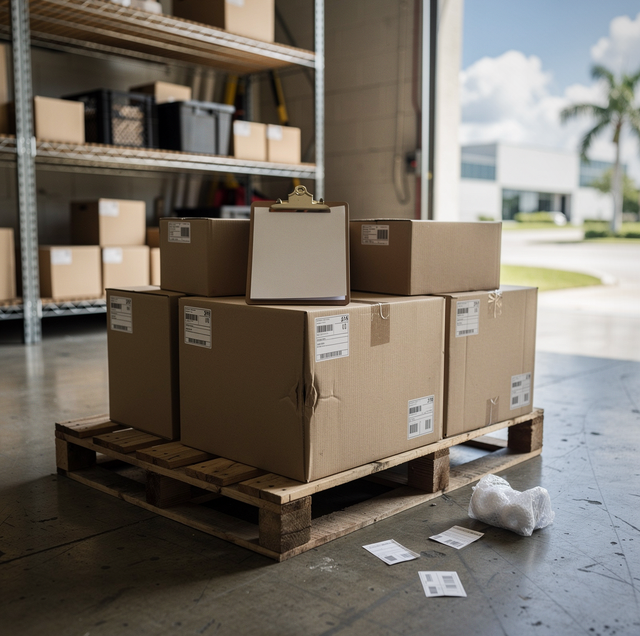
Shrinkage is the difference between the stock you paid for and the stock you can still sell, and it is the sum of several separate causes. Damage flattens cartons before they ship. Theft can remove stock quietly enough that nobody notices until a count comes up short. Misplacement buries a pallet in the wrong bay, where it might as well not exist until someone stumbles on it. Recording errors cause the system to believe there is stock that has already left the building. Spoilage takes product none of the above touched and simply ages it past the point anyone will buy it. Chasing shrinkage as one number misses that each cause has its own trigger and its own storage fix.
| Loss type | Storage practice that cuts it |
|---|---|
| Damage in handling and stacking | Weight-based slotting, stacking limits, and rack use suited to the load |
| Theft | Zoned access and camera coverage on high-value storage areas |
| Misplacement | Assigned locations and location-ID discipline at putaway |
| Recording errors | Scan-confirmed counts tied to the physical location |
| Spoilage | Rotation by receipt or expiration date, not by convenience |
Slotting and Location Control
Slotting is the decision of where each SKU lives, and a warehouse that skips it treats every location as interchangeable. Fast-moving stock buried in a back corner costs time on every pick; that alone isn't shrinkage, but the workaround for it can be. A picker under pressure who can't find the assigned bin sets a pallet down in the nearest open slot instead, and that pallet is no longer where the record says it is. It isn't lost. It's unrecorded, and unrecorded stock behaves exactly like lost stock until someone finds it, or until it's dated and has to be written off.
Fixed locations at putaway: Every pallet gets an assigned address the moment it's received, entered against a location code rather than dropped wherever there's room. That single habit turns "where did it go" into "check the record," a search that takes seconds rather than a walk down every aisle.
Slotting also has to account for confusion, not just distance. Two SKUs that look alike in similar packaging, sitting in adjacent bins, invite a picker to grab the wrong one under time pressure. Separating those pairs by more than an aisle, or forcing a barcode scan before a case leaves its bin, removes the moment where a mispick starts.
Give visually similar SKUs different-colored location labels, not just different numbers, so a picker who reaches into the wrong bin sees the color mismatch before reading a single digit of the bin code.
Handling and Stacking Damage
Damage shrinkage can build without a single dramatic drop. It's a stack built beyond what the bottom tier can carry, a forklift fork catching the corner of a case as it passes, a pallet routed to a bay that wasn't built for its weight. None of these look like theft or a records problem, which is exactly why they get missed in a shrinkage review that only looks for missing units instead of damaged ones still sitting on the shelf, unsellable.
Weight distribution is the first lever: heavier, denser cases go low, and toward the center of a stack, lighter and more fragile cases go on top, and a load that violates that order puts its own bottom tier under a crush load nobody planned for. The second lever is matching the storage method to the product. Rack storage keeps each pallet independently supported on its own beam, so one bad pallet doesn't transmit its weight into the ones beside it the way a floor stack does, where every tier below the top is carrying everything stacked above it.
Orientation and stacking limits: A case rated for a given stack height starts to lose integrity beyond that height, and a facility that lets pallets go one tier higher "because there was room" trades a little floor space for cartons crushed at the bottom later.
A stack built past its rated height can lean, shift. and come down on anyone working the aisle beside it. Keep people clear of a leaning or crushed stack and leave restacking it to trained forklift operators.
Access Control and Surveillance
Zoned access and camera coverage in the areas holding your highest-value inventory reduce opportunities for theft, while the staff assigned to that zone continue working through it without delay.
Rotation (FIFO/FEFO) and Spoilage
Spoilage needs no handling mistake at all: stock ages out while sitting exactly where it belongs, and storage layout decides how much of it you absorb. First-in, first-out moves stock in the order it arrived; first-expired, first-out moves it in the order it goes bad, which matters when receipt date and shelf life don't move together. Either method only works if the storage layout enforces it, because a picker under normal pace takes the case in front of them, not the one buried behind it.
Where pickers choose by reach rather than by a scanned lot, the oldest or soonest-to-expire stock has to sit where a picker reaches it first: at the front of a lane, at the bottom of a gravity-fed rack, or nearest the aisle rather than pushed to the back during a busy receiving day. Storage set up any other way relies on someone remembering to dig. A rack that lets new pallets be loaded from one side and picked from the other enforces rotation by geometry rather than habit, so the oldest case comes out first because there's no other case in front of it to grab.
Backstock isolation: Stock nearing its date, or already dated, held in a clearly separated zone rather than mixed in with sellable inventory, keeps a picker from grabbing it by accident and keeps the write-off decision visible instead of buried on a shelf nobody checks.
Receiving and Shipping Checks
Damage and shortages that walk in the door at receiving become your shrinkage the moment they're shelved without a note. A count and a condition check at the dock, before a pallet moves into storage, is the record that separates a carrier's damage from your own: catch a crushed corner or a short case at receiving and it's logged against the inbound load, not absorbed into your inventory as an unexplained future loss.
The same discipline applies on the way out. A pallet checked against the order before it's loaded catches a picking error while it's still inside the building, where it costs only a re-pick to correct. The same error caught by a customer costs a return and a credit. Receiving and shipping checks don't replace a counting program; they stop the specific errors that get introduced at the two moments goods physically change hands.
What a Warehouse Partner Should Report
A single shrinkage percentage shows how much is lost, not which cause to fix. A useful report breaks the number down by cause (damage, theft, misplacement, spoilage and recording error), because a warehouse chasing theft when the real driver is stacking damage will fix the wrong thing and watch the number stay flat.
That breakdown should also carry a location tag, not just a cause tag. A pattern of damage concentrated in one bay points at a rack, a stacking habit, or a traffic pattern in that specific zone, which is a fixable, physical problem. The same damage spread evenly across the whole facility points to something facility-wide instead, such as training, a handling process, or the inbound packaging itself. A partner worth keeping reports the cause and the bay together, so a fix aimed at one rack or one habit can be checked against the next report.
Frequently Asked Questions
Yes. A location label on the beam face and a pallet label on the side of the load facing the aisle allow a picker or lift-truck driver to scan both from the aisle at every level, without pulling the load out to find the label.
It can. A pallet carries three separate load ratings: static (sitting on the floor), in motion (moving on forks), and racked (spanning two beams with nothing under its center), and the racked figure is the lowest of the three. A load a pallet can carry safely on the floor can be too heavy for the same pallet in a rack position.
Ground-level or first-pick height suits high-turn stock because it reduces how often a forklift has to lift and set the pallet down between the rack and the floor. Each additional lift is a chance for that specific load to be dropped, nicked, or set down off-center.
Obsolescence is stock nobody wants anymore even though it's perfectly intact. Shrinkage is stock that's lost or unsellable due to damage, theft, misplacement, a recording error, or spoilage. The two can land in the same write-off line, but they call for different fixes: a storage change addresses shrinkage, a sales or purchasing change addresses obsolescence.
It can, in ways that don't show up until later. A carton marked for one orientation that is stored sideways or inverted can shift its contents or stress a seal in a way that leaves no exterior sign, so the damage isn't found until the case is opened at a customer's dock rather than at receiving.
When the pick-count ranking of your SKUs shifts, not on a calendar alone. Comparing each SKU's pick count over the last period against its current location shows which fast-movers have drifted into far slots and which slow-movers are holding prime ones, and re-slotting moves only those.
Set up 3PL warehousing for your stock — assigned pick locations, scan-confirmed counts and rotation by receipt or expiration date, with losses reported by cause and by bay. Delivery and Warehousing Solutions serves West Palm Beach, Palm Beach Gardens, and Jupiter. Call (561) 842-0044.